





Since their discovery in the 1990s, VHH antibodies (also known as single-domain antibodies or nanobodies), derived from camelid heavy chain antibodies, have become a significant focus of scientific research due to their unique and advantageous properties. Found in species such as llamas and alpacas, these antibodies are distinct from conventional antibodies because they lack a light chain and possess a single antigen-binding domain known. Their small size of approximately 15 kDa provides greater physicochemical stability and enhanced biodistribution, allowing them to bind to otherwise inaccessible epitopes effectively. These characteristics make VHH antibodies highly valuable in medical and veterinary applications, especially in diagnostics and therapeutics.
VHH antibodies offer several advantages over traditional monoclonal antibodies (mAbs). Their small size allows them to reach epitopes that are not accessible to larger antibodies, and they exhibit greater stability under extreme conditions such as high pH and temperature. Additionally, VHH antibodies have high solubility, are easier to genetically manipulate, and can be expressed in prokaryotic systems at a lower cost. These properties make them particularly suitable for applications where conventional antibodies might fail.
The journey of VHH antibodies began in the early 1990s with a group of researchers led by Raymond Hamers. Since then, there has been significant progress in understanding and utilizing these small binders. In 2001, the biopharmaceutical company Ablynx was established to explore the therapeutic applications of VHH antibodies. Between 2003 and 2010, there was a surge in publications related to VHH antibodies, reflecting their immense potential in medicine. Preclinical and clinical studies during this period paved the way for the first VHH antibody-based treatment, Caplacizumab, approved in 2019 for acquired thrombotic thrombocytopenic purpura (TTP).
VHH antibodies have shown great promise in treating viral diseases. Their ability to bind to specific viral epitopes with high affinity and stability makes them excellent candidates for antiviral therapies. For instance, during the recent COVID-19 pandemic, VHH antibodies were developed to target the SARS-CoV-2 virus, showcasing their potential to address emerging infectious diseases rapidly. While they function similarly to conventional antibodies by recognizing and binding to specific antigens, their smaller size and unique structure allow them to access regions on pathogens that are not reachable by larger antibodies. This makes them particularly effective in neutralizing viruses, which often hide critical binding sites within complex protein structures.1
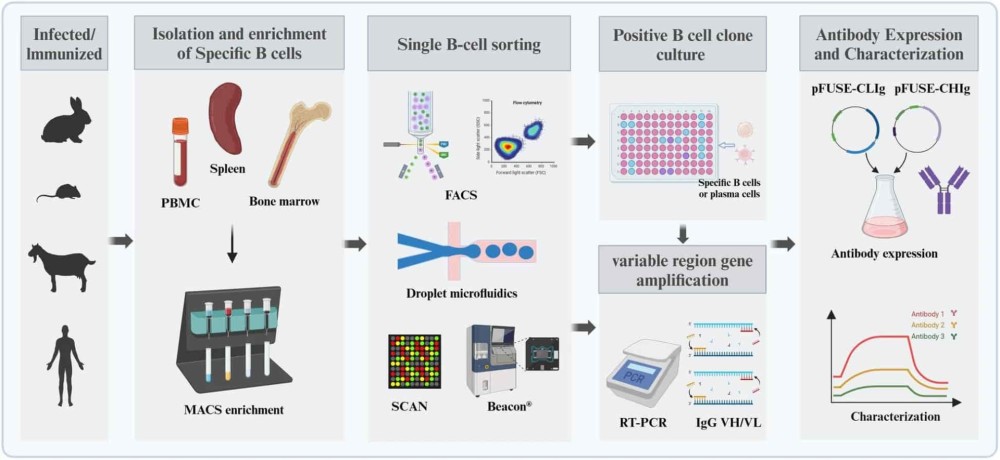
The production of VHH antibodies typically involves immunizing camelids with the target antigen, followed by the isolation of lymphocytes from the immunized animals. RNA is then extracted from these cells and converted to complementary DNA (cDNA), which is amplified using polymerase chain reaction (PCR). The resulting genetic material is cloned into phagemid vectors or bacteriophages, which display the nanobody genes on their surfaces. This creates a phage library that can be screened to identify VHH antibodies with the desired specificity and affinity.
In addition to their therapeutic potential, VHH antibodies are also valuable in diagnostics. Their ability to bind with high specificity and stability makes them ideal for use in diagnostic assays, where they can help detect viral infections with high accuracy. This is particularly useful in the early stages of infection when accurate and rapid diagnosis is crucial. They can also be used in structural biology as crystallization chaperones and in cryogenic electron microscopy, as well as in proteomics, super-resolution microscopy, intracellular applications, and in vivo imaging.2
The future of VHH antibodies in medicine looks promising. Ongoing research and technological advancements continue to expand their potential applications. For instance, new formats, such as VHH antibodies functioning as cytokine surrogates or as cell adhesion molecules for tissue engineering, targeted tissue repair, and the manipulation of immune cell migration and interactions, are constantly being developed. As our understanding of their properties and mechanisms improves, we can expect to see VHH antibodies being used in a wider range of therapeutic and diagnostic applications.
Minatel, V. M., Prudencio, C. R., & Barraviera, B. (2023). VHH antibodies: A promising approach to treatment of viral diseases. Frontiers in Immunology, 14. https://www.frontiersin.org/journals/immunology/articles/10.3389/fimmu.2023.1303353/full
Frecot, D. I., Froehlich, T., & Rothbauer, U. (2023). 30 years of nanobodies – an ongoing success story of small binders in biological research. J Cell Sci, 136 (21): jcs261395. https://journals.biologists.com/jcs/article/136/21/jcs261395/334668/30-years-of-nanobodies-an-ongoing-success-story-of
Biointron announces limited-time RushData launch pricing for high-throughput ant……
August 2026 brought another mix of acquisitions, licensing agreements, strategic……
Antibody discovery often begins with a highly diverse population of B cells, onl……
As larger candidate panels move from computational design into the laboratory, a……